Serpentine Communications
4930 Saint Elmo Ave. Bethesda MD 20814
Tel: (301) 654-2224 Fax: (301) 656-1658


| Calendar |
| About Artemis |
| Classes |
| Items for Sale |
| Workshops |
| Contact Artemis |

| Music |
| About Yasmin |
| Classes |
| Articles |
| Workshops |
| Contact Yasmin |
Egyptian
Music
Also see BOOKS and DVDs
 A LONG ARTICLE ABOUT MUSIC FOR PERFORMING IS BELOW.
Sands
of Time - Sout al Beled
Serpentine releases
traditional Egyptian music
on it's own label
Arranged by Sayed Henkesh
COMING SOON!
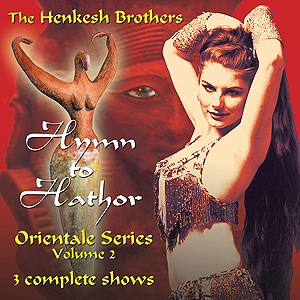 Hymn to Hathor - Orientale Vol 2
SoT009 - The Henkesh Brothers
AVAILABLE NOW !
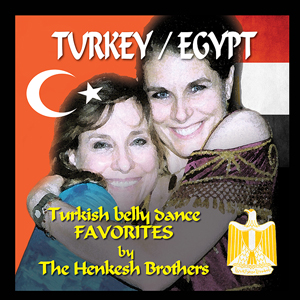 Turkey / Egypt - Turkish Belly Dance Favorites by the Henkesh Brothers - From Istambul via Cairo!
SoT011 - The Henkesh Brothers
This CD is a fantasy come true. Artemis and I wanted to do the unheard of… invite the Henkesh Brothers to record a Turkish dance CD. The timing was right. Egypt had just exploded in its 2011 revolution and the country’s performers were out of work. In a time of suffering, a few of Egypt’s most talented musicians escaped into a recording studio to interpret ten Turkish and Ottoman favorites. The result is a CD that is perfect for all Middle Eastern dancers, no matter their style or skill level. It is ideal for performance, as a teaching tool, or simply to listen to – a must-have for any Middle Eastern music collection. The album’s ten songs reflect Turkey’s ethnic diversity; the Roma (Gypsies), the Greeks, the Sephardic Ladinos and the Arabs. Most of the melodies are centuries old, from Turkey’s Ottoman era. They even include one, Uskudara, that Yisrael Najara, an Ottoman Jew, transformed into a shabbat prayer for his 1587 AD book, Yeshivot Yisrael (The melody can also be heard in Loreena McKennitt’s album Ancient Muse as Sacred Shabbat). The liner-notes, a 36-page color booklet, are filled with cultural references and in-depth descriptions of each song’s history and lyrics.There are 31 tracks in all; two versions of the songs (with and without finger cymbals - Artemis playing Turkish/Vintage Orientale zills in a duet with me on Egyptian sagat) - 10 rhythm tracks for practice and a bonus track, a field recording from 1980s London to turn the musical tables. Here Turkish musicians play an Arabic classic, Ah Ya Zein, for a short “Egyptian” cabaret performance.
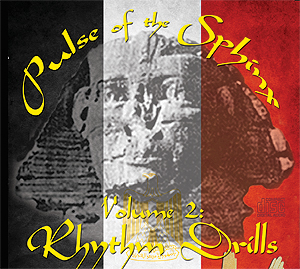 Pulse of the Sphinx Vol. 2 - Rhythm Drills
SoT010 - Reda and Ramadan Henkesh
31 two minute tracks to perfect your knowledge of Middle Eastern rhythms. Ideal for improvisation. Everything from maqsoum and malfouf to ayoub, samba and samaee - plus some hard to find! Includes many complete 2-3 minute drum solos perfect for performing.
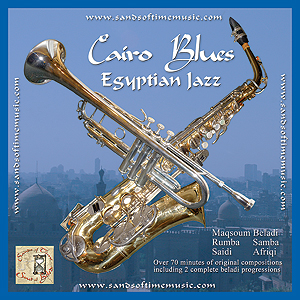 Cairo Blue - Egyptian Jazz
SoT008 - Ahmed Ramaah and Hosein Al-Issawi
Egyptian Jazz with trumpet and sax. Beladi and beyond - From the streets of Cairo comes this fusion of traditional Middle Eastern rhythms with jazz. For dancers looking for new and unusual inspiration, this album is for you. There are two beladi progressions, sambas, rumbas, saidi, fellahi, maqsoum and the unusual afriqi - that will get your feet moving and put your imagination in overdrive. Yet the album succeeds as listening music as well. The unusual combination of Middle Eastern quarter note thrown into a jazz format is intriguing. Something for everyone. An exploration of rhythms including maqsoum beladi, saidi, rumba, samba, Afriqi and fellahi. Includes 2 complete beladi progressions. Over 70 minutes of original pieces. A wonderful listening experience.
THE FINGER CYMBAL DUET - Cymbals Speak Part 1 & 2 - Artemis + Yasmin Henkesh
See this article about the difference between Zills and sagat.
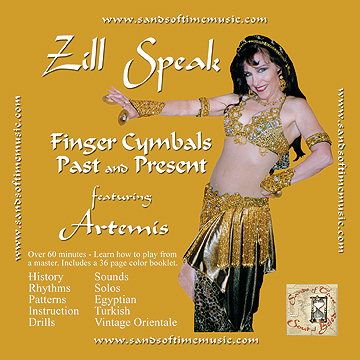 Zill Speak - The A(lmee) to Z(ills) of Finger Cymbals
SoT006 -
Artemis Mourat - 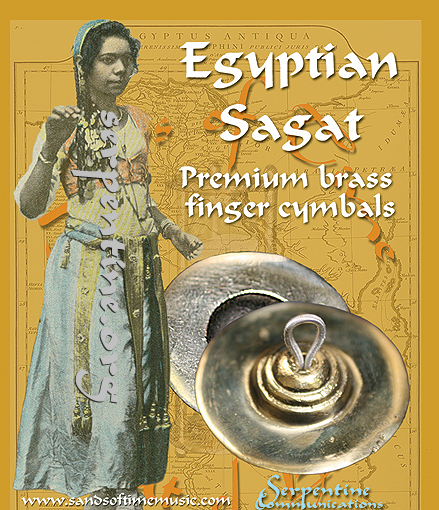 Cymbals Speak Part 1
Learn how to play Turkish / American finger cymbals from a master zillist. Artemis has been teaching and playing finger cymbals for over 35 years. The album contains a 36 page color booklet with tips and tricks to help every zillist, no matter what their level. The booklet is abundant with historical background, diagrams on how to play zills, practical drill exercises, a precise listing of the rhythms by "doom" and "teks" and a unique word pattern rhythm created by Artemis as a learning tool. Teachers and students can navigate to the instruction required by the track listing on the back book cover. Tracks are tied to book chapters and include musical theory explanation, patterns and rhythms, varied playing methods, Arabic and non-Arabic Rhythms, sound and pattern drills and more.
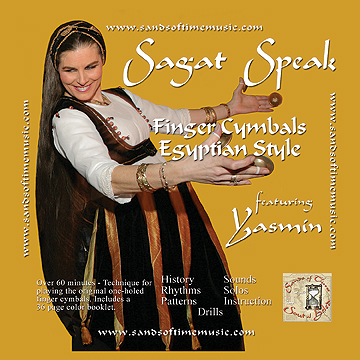
Sagat Speak - Learn how to play Egyptian one-holed finger cymbals!
SoT007 - Yasmin Henkesh - Cymbal Speak Part 2
Cymbals Speak Part 2 - Learn How to Play Finger Cymbals from A(lmee) to Z(ills). This volume is dedicated to Egyptian sagat and the clam-shell method of playing them. The 40 page booklet contains a detailed explanation of how to string, hold and play them, in addition to an extensive history lesson on the origin of finger cymbals and explanations of the many drills included on the CD. There is also a section on the cymbal patterns used by the ghawazees in 1798 as recorded in Napoleon's Description de l'Egypte. The entire section on cymbals has been translated into English and included in the booklet.
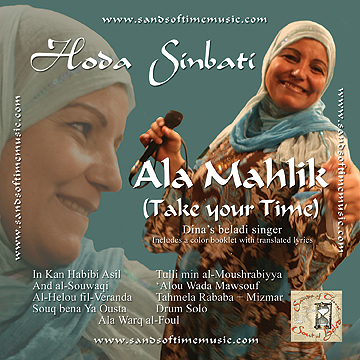 Ala Mahlik / Take Your Time - Hoda Sinbati
SoT005 - Dina's beladi singer
One of Egypt's brightest country music stars sings 7 classic songs: In Kan Habibi 3asil, 3and al-Sawaqi, Souq Bena ya Ousta, Tulli min al-Mushrabiya,'Alou Wada Mawsouf, 3ala Waraq al-Foul and the elusive Al-Helou fil-Veranda. The album contains two versions of each song - one long version, complete with an introductory leyali and mawwal - and a shorter version ideal for performing. The album also contains a tahmela with taqsims by her gifted mizmar and rababa players.
Lyrics to all songs included - transliterated and translated into English.
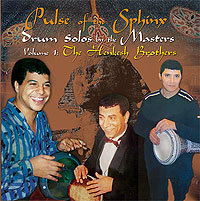 THE FIRST OF THE DRUM SOLO SERIES
Pulse of the Sphinx - The Henkesh Brothers
SoT004 - 10 Performance Solos + Drills
All good Middle Eastern dancers know that if they want to be great dancers they must work with a great drummer. This series is designed to bring Egypt's best drummers to belly dancers around the world. There is no substitute for working with a Master. Volume 1 is dedicated to the Henkesh brothers - Khamis, Ramadan and Reda - who have reigned supreme in Egypt for over 30 years as the drummers to the superstars. Mona Said, Nelly Fouad, Shoo Shoo Amin, Lucy, Ida Nour and Nadia Fouad all have worked with them. This CD has over 60 minutes of solos and has something for every level and style of Middle Eastern dance. The booklet contains articles about Middle Eastern percussive intruments - including finger cymbals, the basic rhythms, dancing to a drum solo and Egyptian shimmy technique. Click here to order.
THE FIRST OF THE ORIENTALE SERIES
Dancing with Genies - Haflah al Afareet
SoT003 - 2 Complete Egyptian cabaret shows  - click here to order.
2 complete Egyptian  style cabaret shows, each just under 30 minutes. Recorded in 2006
in Cairo and mixed in the United States, these shows have been adapted for the time
restraints of Western belly dance performances. The pieces will please the  purist however,
as they were recorded almost exclusively with traditional  instruments. The album contains
an extensive color booklet with translated  lyrics of the songs, a comparison of Belly
Dance shows from around the Middle East and the United States, an article about Egyptian
dance posture, origins of The Jinn and the entire script from Yasmin's movie,
The Egyptian Bellydance Superstars.
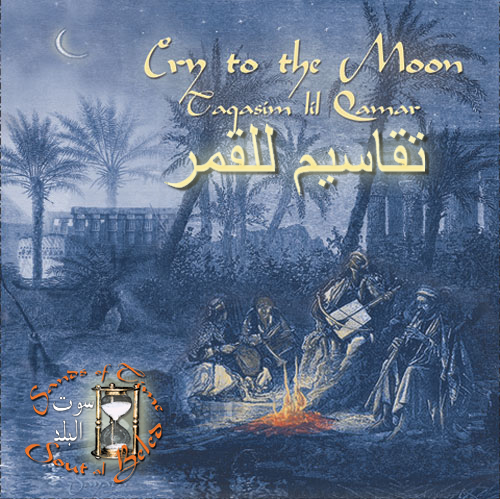 Cry to the Moon - Taqasim lil Qamar
SoT002 Traditional taqasim
Beautiful haunting solos and melodies performed by a traditional Arabic music ensemble,
including instrumental versions of Om Kalthoum's Ana Fintizarik and al-Hob Keda and
Farid al-Atrash's Al-Rabia . The CD also includes a 36 page color booklet about Arabian
musical formats, the instruments and their history, how to dance to a taqsim, biographies
of Om Khalthoum and Farid al-Atrash, in addition to translated lyrics of all the songs.
To order click here.
 The Zar - Trance Music for Women
SoT001 - Zar album details
featuring the famous group Awlad Abou al-Gheit.
For more info on the Zar in general click here.
To order this album from :
- Amazon click here
-
Rashid.com click here - under "Religious Songs"
-
CD Baby click here
Ibrahim Farrah wrote at least 4 articles in 1978 about the Zar for his publication, Arabesque. This was at a time when no one had ever heard of the cult in the United States. He had seen Nadia Gamal do a theatricalized version of the trance dance during her show in 1968. According to him, she was the first oriental dancer to incorporate the dance into a cabaret performance. He loved the head movements, which he had incorporated into his dancing before he ever knew where they came from.
Later, the Zar was adapted into the shows of other famous dancers in Egypt, such as Shoo Shoo Amin and Aiza Sharif, in addition to the repertories of the national Folkloric troupes. To make the dances more dramatic, the performers added frame drum players and incense burners, integral parts of any zar ceremony. There are several videos available in Egypt that show these performances. On one of them Shoo Shoo Amin can be seen dancing to a song which is track #7 on our CD, Ya Benat al-Handasa.
Albums in post production:
-
Zar 2 and 3
-
Layyali wa Mawwal - by some of Egypt's best beledi singers, including Gamalaat Sheeha 1 + 2 and Hoda al-Simbati, Dina's singer vol 2
-
Sayyid Darwish - Egypt's great folk composer from the turn of the last century
-
Zuffa from Egypt
Traditional wedding music
al-Arayis - from Mohammed Ali Street.
Eskandarani - from Alexandria
al-Nubi - from southern Egypt -
Mizmar and Rababa - Ghawazee music
Country music to dance to! -
Sai'idi - for your cane dances.
-
Orientale Series by Sayed Henkesh -
Traditional 'cabaret' music: no synthesizers - only traditional takht ensemble instruments, an accordion and a tabla! Sayed has played accordion for Egypt's best!
-
Drum solo series - Master Drummers of Egypt -
- Andalousi - traditional pieces from Islamic Spain
- Awalim
Let us know if you would
like to be put on our mailing list for release dates.
Music for Performing
A traditional Egyptian cabaret show usually follows the following progression:
Intro / Mergenci
Taqsim
Om Kalthoum
Pop music / folk songs for audience participation
Beladi progression
Saidi cane (prop number)
Drum solo
Finale
(A complete discussion of show styles from the 4 different cabaret traditions is in the booklet for Dancing with Genies)
This can change however depending on the audience. Westerners aren't as fond of slow Om Kalthoum as Middle Easterners. If you are dancing mainly for 'foreigners', then the beladi progression can be placed after the taqsim (which then becomes incorporated into the beladi piece) and the prop number flows directly from the audence participation pieces. I had some bands in the US play the prop piece after the drum solo, but I always felt that was anti-climatic.
Some music is timeless. Here is a list of classic pieces all good Egyptian dancers should know. But that doesn't mean you have to like them. Just know how to dance to them. Some of these were composed over 50 years ago and sound oddly outdated today. There are re mixes of these older favorites on the market, and I have tried to list good ones below. But in general these new renditions can't compensate for a basic change in audience expectations over the years. Certainly the original versions are WAY too long for the standard 5 minute entrance of today's cabaret performances. But listen to them and form your own opinions! Then tell me what you think. Any suggestions of more to add?
 Intros - Mergenci
Aziza -
by Mohammad Abdel Wahab ( Most versions are old-fashioned and too slow for today's
fast pace life.)
Hani
Sit
el Hosen
Masha'al
Tamr
Henna
Mona
Nagwa
Laylet Hob (Slow but a classic)
Sharouk
Bahia
Zeina
Ah Ya Zein
Sahara
Personally I prefer renditions without synthesizers, but I'm a purist.
Taqsim
and Om Kalthoum
As I mention in class there are three different types of taqasim:
one instrument
an instrument with a low drone in the background
an instrument with percussion
Each type of taqsim gives a different feeling to it. The first is a conversation with a single musician, the second is the same conversation with your mother-in-law in the next room listening and the third is a menage-a-trois....
In the Sands of Time Blue Series Cry to the Moon - Taqasim lil Qamar there are examples of all three, mainly with nay (flute), violin, oud, kanoun and accordion. In Cairo Blue there is a wonderful trumpet taqsim as well.
Taqsim Album Review
As a joke I asked my advanced students to make a list of the worst taqasim on the market. Here are 2 that we found:
Nay Taqsim from Nourhan Cairo (Track 8)
A massage CD that just missed its calling!
- half-tone Western chord progressions underneath and nay doing
eastern 1/4 tone progressions - disconnect/dissonance
Dance with Adam Basma - taqsim
Yowling cats complaining about the construction hammering
-The drumming isn't a familiar eastern pattern;
-the synthesizers sounded like wounded animals
- just too busy
We chalked it up to another crime committed in the name of Pharonic music!
What was really so jarring about these solos was that the musicians used Western chord progressions rather than the traditional maqamat.
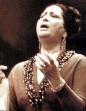
No Egyptian cabaret show is really complete without an Om Kalthoum piece. This is where the dancer gets to emote, show emotion, be serious, stop smiling, act, etc. But she CAN'T do these things if SHE DOESN'T KNOW THE WORDS TO THE SONG! I recently saw a famous dancer in a show grinning from ear to ear as she danced happy happy joy joy to one of Om Kalthoum's saddest songs. I was horrified and disgusted. This was not cultural sensitivity but American stardom at its worst. I have tried to list the songs most likely to be played by a live band during a performance and the lyrics to the songs. If I or my students have found a good version of the song for inclusion in a taped cabaret show I have also included those. Remember though that the original versions of these songs are VERY long, and slow, and repetitive - not ideal for Western audiences.
There are several pages about Om Kalthoum's life in the booklet for Cry to the Moon. She was (and still is) called The Voice of Egypt. She embodied the essence of classical traditional Arabic music, while remaining innovative and in touch with her times. In her 60's her composers wrote songs for her using electric guitars, organs etc. Enta Omri, written for her by Mohammed Abd al-Wahab, was the first of many such songs that used modern music's new inventions. But through it all she kept her link to the traditional and her love of the audience. Her songs were long because the audience requested repeats of lines, phrases and sometimes whole stanzas. She happily complied. Before her health began to fail, her concerts could last for 4 -5 hours - for only 3 - 4 songs. That was definitely a show of stamina and a testimony to the power of her voice. But she was a master at the art of tarab, the goal of any Arabic artist, which was to send her listeners into a state of ecstasy (as they translate it), where time stops and reality is only the sound of her voice and the meaning of her song.
I would like to thank Shira for the wonderful compilation of lyrics she has on her site.
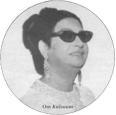 Alf
Leyla wa Leyla
Alf
Leyla wa Leyla
Ana Fi-Intizarak - On Cry to the Moon (lyrics in the booklet)
Al-Hob Keda - On Cry to the Moon (lyrics in the booklet)
Huwwa Sahih
Enta
Omri
Lissa Fakr
Laylat Hob
Hayyarti
Albi
Al Hobbi Kulu
Ansak
Ya Masharni
Daret Al Ayam
Al Atlal
Seret al-Hob
* Qalb Yaashak Likooli Jamil (different emotional quality that other
songs on list)
* Ghannili Shawayyi (different emotional quality that other songs
on list) from Wedad - the first film she acted in
Click here for a place where you can listen to all of them!
Places
to buy her DVDs and music:
Maqam
Rashid - live
recordings one song per CD (they are long...)
Amazon
Amazon
France
 Drum
Solos
Drum
Solos
IN THE 36 page BOOKLET THAT ACCOMPANIES PULSE OF THE SPHINX IS AN ENTIRE ARTICLE ABOUT THE RHYTHMS, WITH ILLUSTRATIONS of the instruments AND MUSICAL NOTATIONS FOR THE MAIN rhythms.
Here is a quick list of Middle Eastern rhythms that I compiled for a recent workshop. It is by no means complete or definitive. But it will give you an idea of just how many there are!
The Percussion Instruments
(Al Iqa’3a)
These are only the main instruments. There are many other types and they vary from country to country. They come in different shapes and sizes. Most are struck with the hands but some use sticks. For our upcoming drum album I will try to list more and the history behind them. Remember, you can see that adorable dwarf on the column of a Middle Kingdom monument beating away at his frame drum. There's also the 3000 year old pair of finger cymbals in the British museum - that look just like the ones in use in Cairo today. (American finger cymbals have 2 slits to attach elastic through, so they won't wobble as much as their Egyptian counterparts, and are made from much heavier brass.)
- Tabla = derbek, darabouka, Arabic drum
- Riqq = tambourine
- Duff = frame drum
- Sagat = finger cymbals, zills
The Rhythms
The Main Beats
(most of them can be included in a drum solo - except the Zuffa and the slow Chifte telli)
CLICK HERE Rhythm Drills - Volume 2 of Pulse of the Sphinx to hear examples
-
Maqsoum - most popular rhythm – 4/4
-
Masmoudi: Kibir + Soughrayir – 8/4 Used in both classical and modern music
-
Malfouf – 2/4 – especially for Intros + Finales
-
Wahda Kabira - Chifte Telli (Ottoman in origin)
-
Ayyoub (Zar) – 2/4 Fast version for Intros and Finales, slow for Zar
-
Fallahi – 2/4 from the country side. Farmers use this for festive songs and women sitting along the Nile sing their melodies to it.
-
Sa’idi – from Upper Egypt 4/4. Used for cane (al-asaya).
- Bambi
-
Zuffa – “the wedding march” 4/4
The Rest
(This is definitely NOT a definitive list!)
- Hagalah - (Bedouin) 2/4 folkloric
- Sama’ai / Andalous – classical Egyptian 10/8
- Darig (masri) – ¾ from classical music
- Sombati – short version of chifte teli - can be lively or slow.
- Three Four – for taqasim
- Maghrebi (North African) 6/8
- Khaliji (Gulf / Saudi Arabian)
- Karachi (Nubian) - 2/4
- Mardoum (South Nubian + Western Sudanese) – 6/8
- Saira (South Nubian + Sudanese) wedding music to show off the bride 6/8
- Shaygiya (south Nubia) – 5/8
- Dishka (Nubia) – 8/8 “The father of Reggae”
- Koumbakash (Nubia) – 4/4 for weddings
- Kiechade (Nubia) – 4/4 for weddings
- Rumba
- Samba
- Fox
- Conga (African)
- Soudasi / Dubki (Lebanese)
- Nawari / Katapofki / Gypsy - (Lebanese) 4/4 uses a large drum hit with sticks
- Hagaah - (Lebanese) 4/4 folkloric
Drum Solo Album Review
Click here for a short list of some of the CDs my advanced class didn't like and WHY:
Sands of Time HAS RELEASED TWO albums in the Master Drummers of Egypt - Pulse of the Sphinx series which feature the Henkesh Brothers. There are also 2 drum solos by the Henkesh brothers on each of Cry to the Moon and Dancing with Genies. One piece, 3 Minute Mona, uses many of the riffs used in Mona Said's famous drum solo of the 1970s.
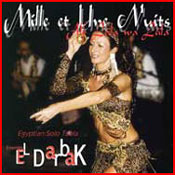 Al
Darbak: Mille et une Nuits
Al
Darbak: Mille et une NuitsA fun compilation of drum solos from France, put out by the French equivalent of the US Bellydance Superstars. (Better dancing, less hype. Sorry, no Tribal. That hasn't caught on over there.) Most of these solos are good for learning / teaching. They are not really designed for a cabaret show. To listen to some clips and learn more about this troup click here. (Warning - the site is in French)
Drummers of the Nile series from Piranha. There are three albums of drum solos featuring Mahmoud Fadl and others. Khamis Henkesh plays on the first. They are not live recordings so they lack sparkle - but they are fun to practice to.
Jalilah / Piranha has a complete rhythm compilation that I like. I believe it is #4.
Nourhan Sharif has a 3 CD rhythm compilation set. I liked the break down of the rhythms. I didn't like the actual drum solos at the end.
I
am NOT a Hossam Ramzy fan so I will not recommend his stuff.
Nightlife
in the Medina
Oriental
Angels
R.E.G. Project - Album #1
Nuits Orientales
Traditional Folklore
Nothing beats Fatma Eid's rendition of Taht as-Shebak for heart-felt folklore. But there's a lot of good stuff out there. Sands of Time has put out an entire album of Egyptian folklore sung by another of Dina's singers, Hoda Sinbati. Many of the songs on there are classics (meaning they are from at least the early 1900s). We have also released a compilation of Turkish folklore melodies, Turkey / Egypt. But the songs are instrumental only, since it was difficult to find Turkish singers in Cairo to record them! It broadens a dancer's capabilities to use older songs, not driven by the simple 4/4 techno beat common in most pop songs today.
Egyptian Pop / Sha'abi
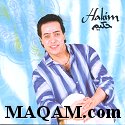
The
Best of Hakim
Abdel Bastet Hamouda
Sa3ad al-Soughayar
Ahmed
Adawia - the oldies but goodies
Hisham
Hoba
Shabaan
Traditional Beladi Progressions
Beladi ya Wad is probably the most well known beladi melody. There is an excellent version of it on Leila's Sukara album. There is also another famous beladi melody that can be found on Dancing with Genies.
Cairo Blue - There are two lovely ones, a sax and a trumpet.
Dancing with Genies - 2 traditional beledi progressions played by a master from Mohammed Ali Street.
Hassan
Abou al Saoud - Master of the accordion. He was the best at playing beladi progressions.
Older albums
Remember Egypt / Folklore Masry
Typical
Beledi songs
Sohair Zuki's beledi - lovely LONG meandering beladi progressions that go on for over 10 minutes sometimes. But that's the way it was done in Cairo in the 1970s and 1980s. A dancer had time to loose herself in them. Great fun to practice to.
Another good Beledi
album
Laura in Beledi
Tiger Music - good authentic beledi CDs but they all end badly
and are not suitable for performance. Bad mixing but good music.
Ghawazee / Fellahin
| Afrah
Baladna Said Hollywood Music |